Showing posts with label Security. Show all posts

Saturday, January 24, 2015

Charles Krauthammer on "Iran's Emerging Empire"

   Charles Krauthammer is talking empire again, this time with regard to Iran. In a Washington Post column he argues that, in the US,  "...Iran’s march toward conventional domination of the Arab world has been largely overlooked." He goes on to criticizes the president and congresses lack of attention to the Iranian backed coup in Yemen in the context of what he sees as alarming actions by Iran in Syria. Essentially, Iran is building an empire in the Middle East while Washington does nothing to stop it.

   As is often the case,  Krauthammer exhibits a pseudo-Realist view of the world as a place where nations vie for dominance over one another. I call this view pseudo-Realist because Krauthammer's analysis has the state- and power-centric characteristics of Realism without the typical view that security maximization is the primary motivation of the state. Thus, his analysis lacks one of the key virtues of Realist theory which is to provide a model of state decision making that applies to all nations. In so doing, it gives us the means to reduce inscrutable and fearsome foreign boogie men to calculating and constrained rational actors that simply have opposing interests to ours given the zero-sum nature of security.

   Of course, there are Offensive Realists, like Mearsheimer, who assume that states are power maximizers instead of security maximizers. But even Offensive Realism invites a more dispassionate and less nationalist view than Krauthammer. Consider John Meirsheimer's 2012 comments on PBS about the effect of a nuclear armed Iran on the Middle East:

I think there’s no question that a nuclear-armed Iran would bring stability to the region, because nuclear weapons are weapons of peace. They’re weapons of deterrence.

They have hardly any offensive capability at all. And if Iran had a nuclear deterrent, there’s no way that the United States or Israel, for that matter, would be threatening to attack Iran now, in the same way that if Saddam had had nuclear weapons in 2003, the United States wouldn’t have invaded Iraq, and if Libya had nuclear weapons in 2011, the United States wouldn’t have gone to war against Libya.

So I think that if you had a Middle East where other states besides Israel — and this, of course, includes Iran — had a nuclear deterrent, it would be a more peaceful region. But the problem is that there is always some small possibility that there will be nuclear use.

And the most likely scenario is what’s oftentimes referred to as inadvertent escalation. And this is where you have a conventional war that starts off with no intention of turning into a nuclear war, but inadvertently escalates to the nuclear level.
   Note in the above quotation that Mearsheimer implicitly applies the same model of decision making to all states and considers the deterrent effect on the US and Israel to be just as valuable for stability as deterrence on Iran. In short, there are no good guys and bad guys, just states with security interests that are both driven and constrained by the relative power of other states. That's a Realist at work.

   But, of course, Krauthammer is talking about conventional "domination" not nuclear proliferation. I used quotation marks because domination is not, theoretically speaking, a clear cut term. I suppose he may means that Iran is seeking to achieve hegemony in the region and Krauthammer does characterize the situation as "Iran's growing hegemony in the region." However, by definition, hegemony is generally a "there can be only one" situation and, regionally, that one is Israel in the Levant and, arguably, the US in the Gulf. So, semantically, talking of Iran's "growing hegemony" is nonsense.

   Iran may be better characterized as challenging Israeli in the Levant and US hegemony in the gulf.  Indeed, it is hard to argue that they are not. It is generally what the Iranians say they are trying to do, and it is also what Realism predicts they will do.

   The question is what should the US being doing about it. From Realism and Krauthammer's state-centric point of view, the US should be trying to thwart Iran's efforts as a general rule. However, the specific situation is complicated by the rise of ISIS which is threatening to take over Syria in the Levant and Iraq in the Gulf region. To the extent that ISIS is a non-state actor, it hits Realist theory in its non-state blind spot.

  However, since ISIS is proclaiming itself to be a state and is taking over territory, it may be that it should be considered a new emerging state in theoretical terms. Furthermore, one might argue that its insurgent strategy is proving to be a surprisingly effective war fighting technology that is upsetting the balance of power in the region in an unexpected way with unpredictable future consequences.

  If you buy this, admittedly, ad hoc modification of Realism, then Realist theory would predict that the US and other powers would have to adjust their alliance structure to deal with the shift in power within the region. Arguably, that is what the US and Iran have done as they have become tacit allies in the fight against ISIS. If the US and Iran seem like strange bedfellows,  it is important to remember that Realism predicts that nations will make alliances based on considerations of power, not national amity or enmity.

   From this point, many of the things Krauthammer decries as US inaction against Iran are actually US actions against ISIS. That is, the US decision to drop demands for Assad's ouster in Syria is attempt to keep an ally in the fight against ISIS. The acquiescence to the presence of Hezbollah fighters and Iranian officers in Syria is acquiescence to the presence of a tacit ally's troops and proxy troops on the field against the common enemy, even if they may up to some other mischief. The administration's reluctance to impose more sanctions on Iran may reflect a reluctance to impose more costs on an ally that is already hurt by falling oil prices and/or a belief that a more conciliatory approach will be more successful in the presence of a new mutual enemy. (Welcome to the pitfalls of coalition warfare.)

   Overall, it appears that the US has made a decision to tolerate marginal gains in power by Iran in order to thwart potentially larger and more destabilizing gains by ISIS. This decision is akin  (albeit on a much smaller scale and without explicit official acknowledgment on either side) to the decision to ally with the Soviet Union in World War II. While that decision had distinct long term drawbacks, any systematic analysis of it would have to take into account the large short term benefits. Therefore, Krauthammer's arguments fall short because he is not considering the impact of the rise of ISIS on the region's distribution of power and the benefits of a tacit alliance between the US and Iran in mitigating that impact.

   To be sure, you could argue that the US is overestimating the threat posed by ISIS to US interests (primarily in Israel and Iraq). Indeed, it may be that, having first underestimated ISIS, US policymakers are irrationally over compensating. Or, you could argue that increased Iranian influence in Syria (and perhaps in Iraq) would be worse for the US than the emergence of a new state in Syria and parts of Iraq. If one is really worried about Iran, one could argue that having a new state to threaten Iran's western border would be a good thing.

   Ultimately, such arguments would be more palatable to Realists who would see ISIS as just another state seeking to maximize its security or power than to non-Realists who might take ISIS's ideology and brutality into account. But then, such non-Realists would also probably take Iran's ideology and brutality into account as well. This would then raise the thorny issue of which nation's ideology is more malignant and which nation is likely to be more brutal.

   Of course, one would only get into such comparisons if one puts the ISIS into the analysis in the first place. While attributing state status to ISIS is problematic in a Realist analysis, it is probably truer to the theory's emphasis (or, more precisely, Neo-Realism's emphasis) on the importance of considering the international system (i.e., the international distribution of power) as a whole. Such an emphasis encourages one not to make the mistake of selectively considering only part of the system as Krauthammer does.

Wednesday, January 14, 2015

Low Oil Prices and Conflict

Last week, I wrote about the drop in oil prices from purely an economic point of view and, in October, I briefly commented on the effect lower prices would have on Putin's regime in Russia; but what about oil prices from a more purely IR point of view? What effect, if any, can we expect on the behavior of states in the international system?

Rob Nikolewski  at Watchdog.org raises this concern in an article entitled Will crashing oil prices make Russia, Iran and Venezuela more dangerous? The gist of this article is that low oil prices are hurting Russia, Iran, and Venezuela and, therefore, their leaders may lash out at the world. However, most of the substantive analysis is an assessment of how much these countries are hurt by lower oil prices, and very little analysis focuses on the motives and strategic calculations of their leadership that would support concerns about them "lashing out."

Indeed, one is left with the impression that Nikolewski thinks the proposition that one can expect aggression from these leaders when they are under pressure needs little more examination than a quote from an expert or two. This might fly with the conservative readership of Watchdog.org but, as IR scholars (and here I am addressing my students), we should be more critical in our reading. We should look at Nikolewski's piece and note that he spends too much time on the suppositional part of his argument (i.e., that lower oil prices are hurting Russia, Iran, and Venezuela) and far too little on the more causal part of his argument (i.e., that this economic pain will encourage more aggression internationally).

This is turn should get us thinking about what the price reaction of the Russian, Iranian, and Venezuelan leadership may actually be. With apologies for another Rex Stout reference, Nero Wolfe frequently tells his assistant, Archie Goodwin to proceed based on "intelligence guided by experience." For our purposes, these twin pillars of intelligence and experience can be interpreted to mean theory (which is logical inference and deduction based on a model of underlying causal relationships) and empirical research (which is the study of past behavior of states).

Taking the second one first,Cullen Hendrix shares some results from his empirical research in a Monkey Cage post entitled Falling oil prices, more peace?  As is typical of scholarly (read, with admitted bias, as "good") empirical research, Cullen starts with some theory, specifically Thomas Friedman's First Law of Petropolitics, which Friedman defines as follows:

The price of oil and the pace of freedom always move in opposite directions in oil-rich petrolist states. According to the First Law of Petropolitics, the higher the average global crude oil price rises, the more free speech, free press, free and fair elections, an independent judiciary, the rule of law, and independent political parties are eroded. And these negative trends are reinforced by the fact that the higher the price goes, the less petrolist leaders are sensitive to what the world thinks or says about them. Conversely, according to the First Law of Petropolitics, the lower the price of oil, the more petrolist countries are forced to move toward a political system and a society that is more transparent, more sensitive to opposition voices, and more focused on building the legal and educational structures that will maximize their people’s ability, both men’s and women’s, to compete, start new companies, and attract investments from abroad. The lower the price of crude oil falls, the more petrolist leaders are sensitive to what outside forces think of them.
The last line of the preceding passage is most suggestive in that it suggests that, when oil prices are low, the leaders of oil exporting states will actually be more constrained by international pressure than when oil prices are high. In other words, contrary to what Nikolweski implies, the leadership of Russian, Iran, and Venezuela may be less likely to lash out due to the current low oil prices.

In his working paper for the Peterson Institute, Hendrix puts this idea to the test, as his abstract very succinctly describes:

Anecdotal evidence suggests high oil prices embolden leaders in oil-rich states to pursue more aggressive foreign policies.This article tests the conjecture in a sample of 153 countries for the time period 1947–2001. It finds strong evidence of a contingent effect of oil prices on interstate disputes, with high oil prices associated with significant increases in dispute behavior among oil-exporting states, while having either a negative or null effect on dispute behavior in nonexporting states.
 Thus, Hendrix's research suggests that high, not low, prices encourage more aggressive behavior (the lashing out that Nikolewski is concerned about) on the part of oil exporting states. It should be pointed out that Hendrix finds only weak evidence to suggest that low prices (below $33/barrel) make oil exporting states more pacific than non-exporting states, so we have to see this as a somewhat one-way relationship. That is, high prices promote more aggressive behavior among oil exporting states and lower prices will not promote such particular behavior.

So, empirical research (the systematic study of experience, if you will) not only casts doubt on Nikolewski's concerns, but paints an entirely different picture of the effect of low oil prices on state behavior. We could leave it there but, sometimes, when confronted with an article that tweak's one critical thinking as Nikolewski's does, there may not be an empirical study so on point as Hedrix's at hand. In such a case, one needs to resort to theory to examine the question in mind.

Hendrix started with Thomas Friedman's First Law of Petropolitics and I generously categorized this as theory. However, a law is technically not a theory but rather an observed empirical regularity, and Friedman is not a theorist but rather a journalist. Indeed, nothing marks the difference between a journalist and scholar so much as Friedman's inexact use of the term "law" in that the term should be used only after an exhaustive empirical study (as opposed to the more anecdotal evidence Friedman depends upon) has established it

Perhaps a better theoretical foundation would have been to use a theory that explains the conflict behavior of  national leaders based on political economy factors. Obviously, Realism is out here as it focuses on system level variables, but my old stand-by of Selectorate Theory clearly applies (and I never miss a chance to pass out the Kool-aid). While Selectorate Theory focuses on the differences in behavior of large versus small coalition regime leaders, it can be applied here since oil exporting states are typicaly small coalition, or non-democratic, regimes.

Back in July, I wrote about Selectorate Theory's predictions about the war making decisions of democratic versus non-democratic leaders (dictators for short). I described the prediction of Selectorate Theory about the war making decisions of dictators as follows:
 In a small coalition regime, the leader (call him a dictator) survives in office with the support of a small coalition of supporters. Because they are small in number, the dictator can best ensure their loyalty by providing them with private benefits. As a result, the leader's survival depends not on his job performance as a national leader, but on his ability to keep the flow of private benefits to supporters going. As long as the private benefits flow to the leader's essential supporters, the leader is free to do whatever he wants with regard to policy, including the prosecution of a war. However, the leader will have only the resources he has left over after paying off his supporters to devote to the war effort.
I have added emphasis to the last sentence because it points to an important consideration for dictators who depend on oil revenue to pay private benefits to supporters. When the price of oil is high, the dictator will have more money left over after paying off his/her supporters than when prices are low. Therefore, the leader will have more resources with which to conduct wars, or any other policy, when oil prices are high than when they are low. Therefore, we should see more aggression when the leader has excess resources to carry it out than when the leader is scrambling to find enough money to pay off supporters. More importantly, even if a leader may be more inclined to be internationally aggressive when oil prices are low, the leader will have less resources to act on the inclination.

Indeed, to the extent that the leaders of Russia, Iran, and Venezuela depend on smaller rather than larger coalitions of supporters, they can be expected to focus on keeping the private benefits flowing to key supporters more than on international adventurism. This is because the leader's domestic political survival is at stake and the theory assumes that this overrides other considerations. Of course, this assumption is supported by the argument that, if leaders don't act to ensure their survival, then they will be far less likely to survive in office.

In short, we shouldn't theoretically expect low oil prices to make the leaders of oil exporting, small- coalition regimes lash out internationally. Given that most oil exporting states have small coalition regimes, this lines up well with Hendrix's empirical finding that oil exporters are less dispute oriented when oil prices are low than when they are high. As Nero Wolfe would say, this reveals Nikolewski's concerns to be fatuous.

Monday, April 14, 2014

Conventional Security Wisdoms from WWII

When talking about security issues, it is natural to draw on historical examples. However, very frequently, the lessons of history that we have in our heads are really just conventional wisdom’s that have been passed around the society. This is particularly true with World War II, which is spawned a lot of conventional wisdom’s that, while not completely false, don’t hold up to very close scrutiny.

One conventional wisdom that I find irksome is the notion that the United States was unprepared for World War II. While the US was certainly not prepared enough for the conflict that emerged, the US actually had taken a number of significant steps to improve its readiness. Starting in 1934, Congress began increasing the size of the U.S. Navy. Their efforts were led by the chairman of the House Naval affairs committee Carl Vinson (the one we named an aircraft carrier after) and this led to a series of acts that marginally increase the Navy. For instance, the Naval act of 1938 , also known as the second Vinson act, mandated a 20% increase in the Navy largely in response to the Japanese invasion of China in the German annexation of Austria. In July 1940, Congress passed the two Ocean Navy act, which mandated a 70% increase in the size of the Navy, with the goal of allowing the Navy to operate in both the Atlantic and Pacific oceans (hence the name). While the US found itself lacking in aircraft carriers at the start of the war, it had 2 new battleships (the North Carolina and Washington) on hand and 8 other battleships building. 4 of these joined the fleet by August 1942 thereby making up most of the losses at Pearl Harbor. [Note: The new battleships were fast and bristling with anti-aircraft guns. Rather than being vulnerable to air attack, they were formidable area air defense systems and were primarily used to protect the carriers from air attacks.]

As far as the Army goes, the United States launched its first peacetime conscription in 1940 with the Selective Training and Service Act of 1940.  The US also mobilized 18 National Guard divisions and 29 aerial squadrons for per year of training and reorganization. A US Army history of the mobilization gives the sense of an Army under great pressure to expand when it makes the following claim:
“Although full-scale mobilization remained politically impossible, the government started the financial transition from parsimony to abundance. Appropriations came faster than the Army could absorb them, over $8 billion in 1940 and $26 billion in 1941, dwarfing the half billion dollars that had been allotted for expansion early in 1939. By the time of Pearl Harbor, Congress had spent more for Army procurement than it had for the Army and the Navy during all of World War I.”
Unfortunately, these numbers appear to be a bit inflated (perhaps the author was using inflation adjusted dollars). If we look at historical figures on defense spending from 1939 to 1945, we see a smaller, but still dramatic, up tick in US defense spending in fiscal year 1941 (Oct 1, 1940 to Sep 30, 1941):
FY1939  $1.9 billion
FY1940  $2.2 billion  (15% increase over previous year)
FY1941  $7.2 billion  (227% increase over previous year)
FY1942 $27.1 billion (165% increase over previous year)
FY1943 $70.4 billion (159% increase over previous year)
FY1944 $86.5 billion (22% increase over previous year)
FY1945 $93.7 billion (8% increase over previous year)

The $7.2 billion in FY1941 doesn't sound like a lot of money to us today, but in 1941, the entire GDP of the United States was only $129.4 billion. This means that the United States spent 5.5% of its GDP on defense in 1941 (rather from Oct 1940 through Sep 1941). Also, it is interesting to note that the biggest percentage increase in defense spending occurred in fiscal year 1941 prior to the attack on Pearl Harbor. . When you add the specter of drafting people into the peacetime military for the first time ever, one certainly doesn't get the impression of a nation sitting idly by while the world burns around it.

A corollary to the unpreparedness wisdom is the conventional wisdom that the United States was pursuing an isolationist policy. To be sure, there was a strong strain of isolationism in US policy, which led to the passing of a number of neutrality acts in the 1930s. However, from 1940 on, the US was in fact beginning to take fairly aggressive steps on the international stage.

In December 1940, Pres. Roosevelt declared the United States, the Arsenal of Democracy in a radio address promising to help Great Britain fight Nazi Germany.  The US at that point was selling arms to belligerents, albeit on a cash and carry basis, and continued to do so until it became clear that the UK could no longer afford to buy weapons. In March 1941, Congress passed “An Act to Further Promote the Defense of the United States”, better known as Lend-Lease. Under this policy, the United States provided more material to Great Britain, China, and the Soviet Union free of charge (albeit subject to a vague promise to return the material when the war was over).

The US efforts did not stop here. In September 1939, at the very beginning of the war, the United States established a neutrality zone in the north Atlantic. The U.S. Navy began the first of what we called Neutrality Patrols  that would observe and report the movement of warships west of latitude 65° and protect merchant shipping within this zone. Despite the name, neutrality patrols greatly favored the British as it relieved them of the responsibility for protecting shipping i about half the North Atlantic. Furthermore, in June 1941, the United States occupied Iceland, which the British had invaded in 1940 to prevent it from falling into German hands.

Meanwhile, in the Pacific, United States was taking an even more aggressive stance towards Japan. In September 1940, the Japanese occupied French Indochina in the United States responded by cutting off exports of scrap metal to Japan (74% of Japan scrap iron and 93% of its copper came from the US) and closing the Panama Canal to Japanese shipping.  In early 1941, the US Pacific Fleet was moved from San Diego with the intention of restraining Japanese behavior. Negotiations ensued but continued Japanese aggression in China led the US to freeze Japanese assets in July 1941 and to embargo all oil and gasoline exports in August.  Since 80% of Japan’s oil came from the US, this was a particularly dramatic step as it left the Japanese with about a 2 year supply of oil on hand and an urgent need to secure new supplies.

Essentially, the United States put Japan in the position of choosing between withdrawing from China or securing access from someplace else to the resources it needed to continue its conquest of China. The closest oil to Japan was in the Dutch East Indies, today’s Indonesia, and the Dutch had already refused to sell them enough oil to continue their war in China. This led the Japanese to plan for an invasion of what they called the Southern Resource Area. However, the British naval base at Singapore and the US naval bases in the Philippines lay on either side of the sea route to this area and, therefore, had to be secured as part of Japan’s massive Southern Operation. This set the stage for a war with the US and the UK (not to mention the Dutch and Australians).

It is interesting to note that a Gallup poll taken shortly before the Japanese attack on Pearl Harbor asked Americans. “Do you think the United States will go to war against Japan some time in the near future?”  52% of respondents said they expected war with Japan, while only 27% did not, and 21% had no opinion.  So, while the attack on Pearl Harbor was shocking surprise, the war itself was hardly unexpected.

Tuesday, April 01, 2014

Oil, Interdependence, and the Likelihood of War

There are two very good new posts on the Monkey Cage today.

Petro-aggression: How Russia’s oil makes war more likely by Jeff Colgan: Colgan notes that much of the current discussion about the role of energy trade in the Crimean Crisis focuses on the effect of the trade on Ukraine or Europe. He argues that the more important effect is on Russia.
Russia’s energy revenues (from both oil and gas) have ensconced Vladimir Putin as an autocrat and given him a free hand in foreign policy.  Russia is so heavily dependent on its energy revenues that it is a classic petrostate, making it more susceptible to corruption, autocracy and violent conflict.
 Russia’s incursion into Crimea can be seen as a close cousin of petro-aggression.  A state is more likely to instigate international conflict when it has a combination of (a) oil income and (b) a leader with aggressive preferences.  A lot more likely: 250 percent more military conflict than a typical non-petrostate, on average.  Oil income means more military spending, increasing the state’s scope for potential conflicts.  Even more importantly, it distorts the domestic politics of the state, reducing the leader’s domestic political risk from military adventurism and aggressive foreign policy.

What World War I can tell us about international commerce and war today by Erik Gartzke and Yonatan Lupu: The authors note that WWI is often viewed as a counter example to the argument that economic interdependence will force nations to show restraint in the use of force. Gatzke and Lupu argue that WWI is not as strong a counter example as it appears to be. In their words:
The growth of international economic exchange in Europe before the war was uneven.  Much of Western Europe belonged to a highly interdependent subsystem of states in which crises arose but were resolved peacefully.  By contrast, economic interdependence was much shallower in most of Eastern Europe and parts of Central Europe.  The Ottoman Empire, Serbia, Austria-Hungary, and several other newly independent Balkan states traded relatively little with each other. Unlike in the interdependent West, crises in this region tended to escalate to war.
It is no coincidence that World War I was sparked among the non-interdependent states in Eastern Europe.  Economic ties played an important role in averting escalation to major warfare in the crises that led up to the Great War, especially in the first and second Balkan wars.  These crises, however, produced the need for the more economically integrated countries, most importantly Germany and Russia, to demonstrate an increasing resolve to support their weaker, less interdependent, allies, Austria-Hungary and Serbia.  Alliances tightened after Germany and Russia took turns backing down under the pressure of war in previous crises.  Tighter alliances increased the leverage of Balkan allies, but only by in effect handing the foreign policies of the interdependent powers over to countries that were less well integrated into the world economy, and thus had fewer reasons not to engage in war.
 As for what lessons we can draw about today's world, Gartzke and Lupu argue:
The size and organization of existing trade networks suggest that Asia, like western European powers in the decades before World War I, is more likely to manage secondary crises without bloodshed.  If interdependence works as theorized, disputes such as those over the Senkaku/Diaoyu Islands are more likely to be occasions of considerable posturing and no actual force.   While no one likes to be the loser, excessive brinksmanship is not a practical strategy in the world that Japan, China and other developed nations inhabit today.  Discretion is likely to rule these relationships, even if there is occasional grumbling from those on the short end of the stick.  There is much to gain from tough talk, but more to lose by failing to pull back from the brink.
The larger risk to international stability today comes from nations cast in the role of the Eastern European powers a century ago.  Lacking economic inhibitions and with no other methods to advance themselves, sovereigns in some countries will find it useful to heighten international tensions.  North Korea is a prime example.  Russia is on the cusp.  Reliance on energy exports rather than a more diversified trading base has allowed President Putin to bluster more often and occasionally to engage in naked aggression, if only against minor powers so far.  Fortunately, fewer of these countries exist today and most are on the periphery of the international system, not near its center.

Wednesday, March 26, 2014

Quick Points: Russian Strength and the US in a Long War

I am very contrary before my first cup of coffee, and two headlines in the news got me thinking (to the point of blogging).,

Russia: First there is this one from The Wire, "Obama: No, Romney Was Wrong. Russia Is Weak, Not Strong." First of all, I thought (and still think) that Romney was way off when he said that Russia was the United States' number one geopolitical foe. If you measure a foe by its intentions, North Korea and Iran seem to be more of a problem. If you measure a foe by its capabilities, China, India, heck the EU are all more likely candidates for the top slot. Russia just doesn't make the cut.

But does that mean that Obama is right when he says Russia is weak. It think is is pretty clear that Russia is not weak in the Crimea or Ukraine. While Obama is quite right to call Russia a regional power, Ukraine is in Russia's region where Russia has much more power than the US. Of course, this imbalance exists largely by default since the US has never really had any vital interests in the Black Sea (the term "backwater seems appropriate here). In contrast, Russia does.

I would also point out that the Europeans have much more at stake with Russia and Ukraine. Not only are they much closer, but they are more economically intertwined with both nations. US trade with Russia amounts to about $20 billion/year, EU trade amounts to about $240 billion/year. The EU gets 33% of it natural gas from Russia, mainly through pipelines running through Ukraine, and this amount of natural gas cannot be acquired from other sources. Since pipeline have two ends, Russia also cannot sell that much natural gas to other customers and its economy is very dependent on energy exports. So, Europe is probably as ''strong" as the US in this situation.

US in a Long War: Then there is this headline from Reuters: Deep budget cuts may erode U.S. Army ability to fight long war: general. IN the article, Gen. Ray Odierno expresses doubts that the proposed $496 billion 2015 defense budget would allow the US to  "execute one prolonged, multi-phase operation that is extended over a period of time." While I understand his concerns about the defense cuts, I have to wonder who he thinks the US would be fighting a long war against. Even with the proposed cuts, the US would be spending 4 times as much on defense as the next largest defense spender, China.

Also, what kind of war are we talking about here? Odierno has a lot of experience in Iraq and Afghanistan, but the long portion of those wars was a counter-insurgency not an interstate force-on-force conflict. Indeed, the force-on-force portions of those wars were stunningly brief and required far less forces than conventional military thinking at the time imagined. We look back at Bush's "Mission Accomplished" banner as a sad joke, but we should remember that it did signal the end of the conventional phase of the war in Iraq. The counterinsurgency didn't get going until the US had obliterated the Iraqi government and military and found itself in the role of occupier.

The lesson one might draw here is that modern wars against other militaries don't last long but wars with segments of a nation's population do. Therefore, if you envision the US getting into a long war, you are probably talking about a case in which the US has defeated another government and is occupying some (or all) of its territory, or one in which the US has committed forces to support a government in a protracted counter-insurgency. In the first scenario, the immediate external threat from the other nation, which threat presumably sparked the conflict, has been eliminated and the US is dealing with a messy aftermath. In the second scenario, the US is intervening to help a government whose resources have to be factored into the equation and, if those resources are not substantial, one has to question whether the US should or would be involved in the first place.

If you buy that reasoning, then the question for the US is whether being less able to deal with those scenarios poses an acceptable or unacceptable risk to US national security.


Thursday, March 20, 2014

China's Tough Neighborhood

To a lot of people in the US, China appears to be the new Big Bad in the world. China is modernizing its military, acquiring aircraft carriers and has developed a ballistic missile to sink our aircraft carriers. This appears to be evidence that China is trying to assert its dominance in Asia and intimidate other nations. The problem with this analysis is that it doesn't consider the extent to which China is itself dominated and intimidated by other nations.

 China lives in a fairly tough neighborhood. It shares a border with Russia, North Korea, India, and Vietnam. South Korea, Taiwan, and Japan are also close by the Chinese coast. According to Global Firepower's ranking of military power, four of these nations (Russia, India, Japan and South Korea) are among the top 10 most powerful militaries in the world.  Taiwan falls in the top 20 and Vietnam comes in at 23rd. China can only count the troublesome North Korea as an ally, though it does have good relations with neighboring Pakistan, Kazakhstan, and Myanmar. (In contrast, the United States borders Canada, ranked 16, and Mexico, ranked 33rd. Among the top ten most militarily powerful nations, 6 are close allies of the US.)

Not only are China's neighbors well armed, but there is a history of armed conflict between them and China. While most Americans are aware that China was North Korea's ally in the Korean war and may be aware that China was invaded by Japan in what would become World War II, but many are not aware that China has had conflicts with other neighbors since then. China has fought wars with India in 1962, with Russia (the the Soviet Union) in 1969 and with Vietnam in 1979. Of course, China has an ongoing dispute with Taiwan over its de facto independence, a subdued dispute over its annexation of Tibet, and administers a portion of Kashmir.   In short, China does not have to look far to find security concerns, even if the United States wasn't in the picture.

Among all the regional threats it faces, in many ways, Japan looms the largest. While the United States may be China's biggest military threat or rival,  Japan is the traditional enemy. From the typical American's point of view, World War II started with Pearl Harbor, but, from the Chinese point of view,  the War of Resistance Against Japan had been going on for 3 1/2 years by December 7th 1941. Though estimates vary, Rana Mitter estimates that 14 million Chinese died in the war and a news article in a 2005 China Daily article cites a figure of 35 million Chinese dead and wounded.  Also, there is little dispute that the Japanese committed many war atrocities. Indeed, the photos taken by Japanese soldier are still circulated on Chinese websites.

In his 2020 book, Modernizing China's Military, David Shambaugh argues that anti-Japanese sentiment runs deep among officers of the Chinese People's Liberation Army (or PLA):
The anti-Japanese sentiment one encounters among the PLA at all levels is palpable. Distrust of Japan runs deep, transcends generations, and is fairly virulent among the generation of PLA officers in their forties and fifties. Japan stimulates an emotional reaction not evident even in anti-American diatribes. In conversations with PLA personnel, Americans are regularly subjected to the view that the United States is naïve to consider Japan as an ally or partner, and they often counsel the United States to be wary of Japanese intentions and military ambitions.
It is interesting to note that the virulently anti-Japanese "PLA officers in their forties and fifties" would now be in their 50s and 60s which is generally the age of generals in the military. For instance, China's Minister of Defense, Chang Wanquan, is a general who was born in 1949, making him about 65 years old. You will also notice that the Minister of Defense is not a civilian, as is the case in most Western nations. While one might be tempted to dismiss Chinese concerns about Japan's military ambitions as overblown, one cannot deny that they exist, especially in the Chinese military.

One might also ask how overblown those concerns are. Despite its constitutionally mandated pacifism, Japan is one of the top ten nations on Global Firepower military power index. With an economy only a bit smaller than China's, it could spend as much as China on its military and its ties with the US ensure that it would have access to the best technology available. Not to mention, the Japanese are no slackers when it comes to producing high technology themselves. Therefore, it is probably not much of an exaggeration to say that the only weapons the Japanese don't have are the ones they don't want.

Furthermore, the Japanese appear to have been edging up their military capabilities over the past few years. Nothing illustrates this better then the picture below that shows the latest two generations of Japanese "helicopter destroyers" side by side. The smaller ship is the DDH-181 Hyuga class ship (of which Japan built two, commissioned from 2009 and 2011) and the larger one is the DDH-183 Izumo class ship (which is to be officially commissioned next year while another ship of the class is currently being built).


One would be excused for commenting that these ships look very much like aircraft carriers, or what passes for them in navies other than f the USN. While the Japanese claim that these ships are for anti-submarine warfare, it is not hard to imagine that they could be used for amphibious or strike operations with some modification and the acquisition of the right aircraft (say the V-22 Osprey and the F-35B, though there are some technical complications involved in using the latter). As it stands the Japanese are already embarking only half as many helicopters as these ships can accommodate, thus keeping a good amount of capacity in reserve. Also, it is worth noting that all the European navies combined only have four carriers between them (though the British are working on two more). [Okay, this is just one weapons system, but I think it gives you a better visceral sense of Japanese modernization than simply quoting a defense expert or citing planned Japanese military purchases.]

Of course, one sticking point with the carriers is that, by law, Japan is not allowed to have "aircraft carriers", hence the name "helicopter destroyer".  But, one look at these ships and the growth in size between the two classes of ships suggests that the Japanese are either fudging their law or hedging their bets against a future change in it. If you are a Chinese general ( they don't have admirals or a separate navy for that matter), you probably see this as proof that the Japanese are not constrained by their laws as much as they claim and are a growing military threat that might grow faster in the future.

Then, there's the US. As the largest military in the world, the US must be reckoned with, and that reckoning has become increasingly difficult over the years. Suppose you were General Chang Wanquan. When you started your career in 1969, the US was embroiled in Vietnam and the North Vietnamese were able to put up a good fight. US air power was fierce some but Russian supplied surface to air missiles and fighter aircraft put a serious dent in it (there actually were North Vietnamese aces in those days). Vietnamese ground forces took disproportionate casualties, but, again, they could inflict enough casualties on US forces to eventually make the US go away.

In general, this boded well for China's defense strategy which was based on Mao's concept of a war of resistance. This plan relied on what is known as strategic depth and involves retreating in the face of a strong invading army to draw them into the interior of the country. Then, when the enemy is weakened by long supply lines and the demand of holding large amounts of territory, harassing attacks are used to sap their strength. The when the enemy is weakened enough that they begin to pull back, an all out offensive is launched to drive them out of the country. With many technical variations, this was the general plan and the Chinese prepared for it by amassing a large cheaply equipped military with and even larger reserve force, distributing forces around the country with the intention that they fight were they live, and locating strategic industries and military resources in the interior of the country.

For twenty years, this is more of less the plan and, though there are increasing concerns about the technological inferiority of Chinese weapons, it seems like a workable plan. Then, in 1991, the plan goes to hell when the US blows through Iraqi forces, which were better equipped than most Chinese forces,  in Operation Desert Storm. So, when Chan Wanquan becomes a Division Commander in 1992, the PLA is in the process of rethinking its doctrine and coming to terms with the fact that it needs to modernize its weapons systems and forces. (Shambaugh, 2002, p. 69-74)

In 1999, when Chan Wanquan was a Major General directing the University of National Defense, the NATO air war in Yugoslavia, provides more sobering lessons. Western air forces appeared to be able to obliterate air defenses better than those possessed by China and to attack targets with long range precision guided weapons with impunity. This rendered the concept of geographic strategic depth as meaningless and provided a chilling example of what the US and Japan might do to China if it invaded Taiwan (Shambaugh, 2002, p. 74-76).

At the same time, China's rapid economic development has changed the nature of what the PLA has to defend. The growth of the Chinese export industry has shifted manufacturing, and much of the population, from the interior of China to coastal regions. The need to import large volumes of industrial import and export equally large volumes of export overseas means that the PLA can no longer be content with simply defending China's borders, much less do so with a plan that involves retreating to the country's interior (tough that plan was dropped in the 1980s).

Of course, the US has arguably not fared so well in Afghanistan and Iraq. However, the difficulties that the US faced in fighting a counterinsurgency campaign, which would have been very heartening to the Chinese when they were planning to fight a protracted war of resistance back in the 1970s, may be of little comfort to them in their current situation. Indeed, the demonstrated difficulty of counterinsurgency might be downright chilling if the PLA considers the possibility of occupying Taiwan itself. Furthermore, if one focuses on the early more conventional phases of the war in Afghanistan and Iraq, the US demonstrated an increased ability to rapidly rapidly government military forces with relatively few ground forces of its own. This might suggest to them that, even if they took Taiwan, they would not be able to keep it for long.

The overarching point here is that, even though the Chinese military has been modernizing and developing new capabilities, the bar they need to jump over has been rising as well. Though their military capabilities have been increasing, both the demands placed on it (in terms of what they need to defend) and the militray capabilities of potential opponents have also been increasing. It is hard to say whether their capabilities have lost or gained ground on their security demands and potential opposition. In that context, the prospect of a US pivot towards Asia is probably a fairly frightening thing to China's defense planners and this is something to keep in mind as you interpret Chinese actions.

Friday, March 14, 2014

Security Factoids for My POL2260 Students


As I welcome new students to my World Politics class, I thought I would offer up some factoids that provide a partial snapshot of the world. In International Relations, security concerns always seem to come first, so this post will look at violence around the world.

To be honest, I often hear people talk about the world being more dangerous nowadays and I have no idea what they are talking about. Part of it is a generational thing. I grew up during the Cold War when mutual assured destruction was only a 30 minute minute missile flight. As a kid growing up in NJ, I could see the Twin Towers from my bedroom window and was all too aware that New York City was undoubtedly the target of several Soviet ICBMs. As horrific as the 9-11 attack on the WTC was, it pales in comparison to the destruction that hung over our heads during the Cold War.

Cranky old-guy ramblings aside, as a scholar I also look at the data and it almost universally describes a world that is less violent and conflictual.   First, consider the level of conflict between nations, which is the traditional source of man-made death and destruction. The 2013 Human Security Report has a couple graphs (below) that show that number of battle deaths from state based conflicts (what most folks call wars) and the number of conflicts themselves have decreased since the end of the Cold War. (Note: the captions to the graph are from the original figures in Human Security Report.)


While interstate conflict and warfare is not quite a thing of the past, we have been seeing very little of it lately and that is a very encouraging sign. Of course, the fact there has been little of it lately is no guarantee that more of it won't flare up in the future, but we should not be blind to the fact that we are living in an uncommonly peaceful time. Indeed, the 2013 Human Security Report examines the debate over whether or not we are in the most peaceful period in all of human history.

If this doesn't make you feel sanguine about national security, it is worth pointing out that the US currently spends far more than anyone else in the world. Indeed, the Center for Arms Control and Non-Proliferation estimates that in 2012 the US spent 6 times as much as on defense China, 11 times more than Russia, and 27 times as much as Iran. Indeed, US spending accounted for 41% of global defense spending in 2012 and  is equivalent to the amount spent in the same year by the next 15 largest defense spenders in the world. Furthermore, eleven of those 15 nations (Canada, Israel, Italy, Australia, Germany, South Korea, Germany, France, Saudi Arabia, Japan, and the UK) have close security ties to the US and two (India and Brazil) are democracies that do not appear to pose a threat to US interests.

Of course, China's economy is growing and, along with it, their military budget. If, and when, the Chinese economy approaches the size of that of the US, it is conceivable that they could spend a comparable amount on their military as the US. However, they currently spend about 1.24% of their GDP on defense (about the same percentage as Germany and Italy), which is far less than the roughly 4% that the US spends. So, even if the US cuts defense spedning, it will be in the lead for a while. It also is interesting to note that the Chinese spend about as much on building High Speed Rail ($100 billion) as they do on their military ($102 billion though some estimates run as high as $126 billion). Therefore, while Chinese military growth bears watching, we should not be overly alarmed by it at present (or we might leave part of the worrying to Japan).

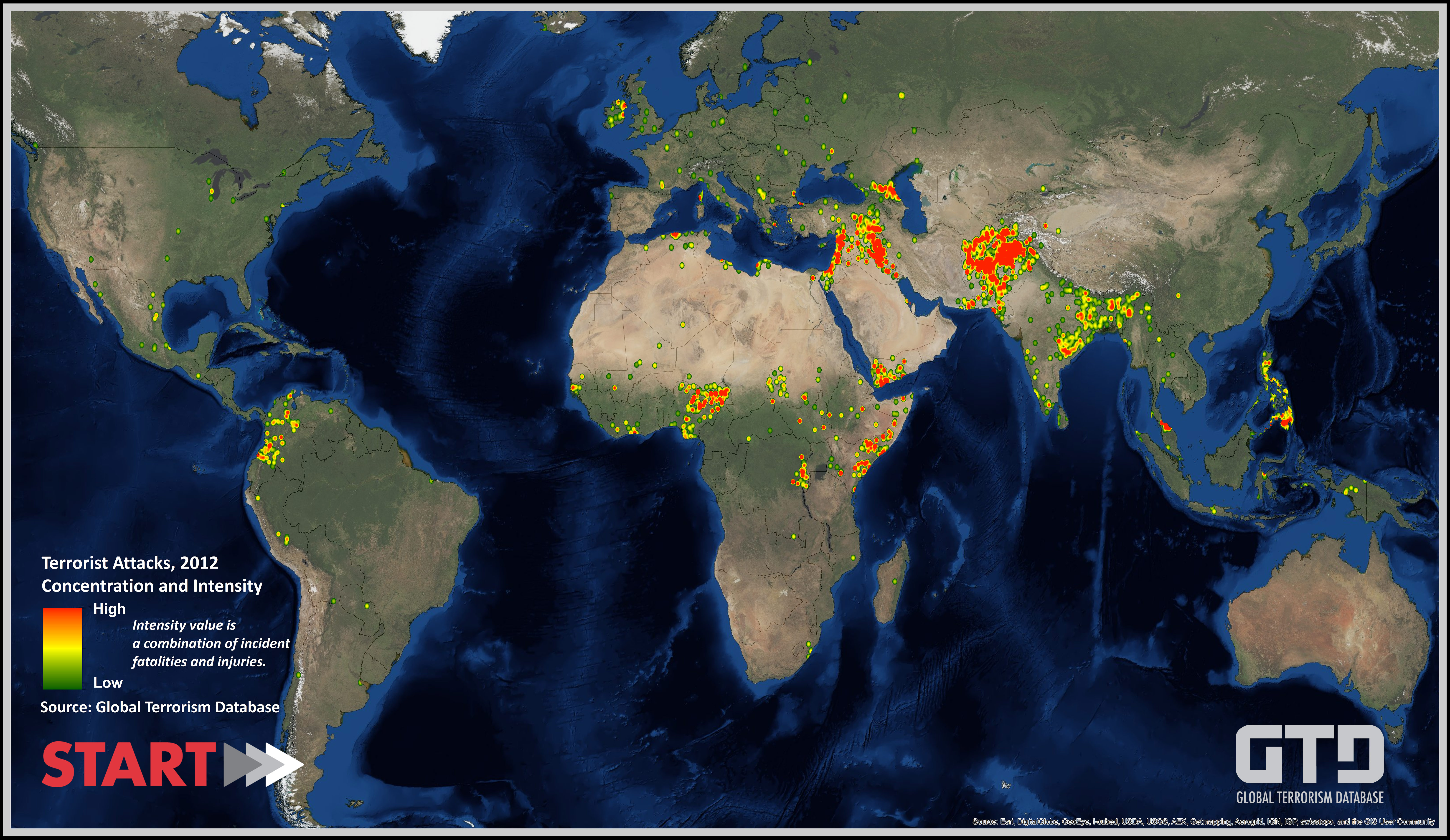
Okay, that's a quick look at interstate security, but what about terrorism? After all, concerns about terrorism are almost certainly on people's minds when they say the world is more dangerous. The National Consortium for the Study of Terrorism and Responses to Terrorism (or START) reports that terrorist attacks have been increasing in frequency and destructiveness over that past few years. In 2012, saw a record high of 15,400 people killed in terror attacks, which exceeds the previous high of 12,500 in 2007. However, 54% of these attacks and 58% of the deaths from terror have been concentrated in three countries: Pakistan, Iraq and Afghanistan. START  has a nice interactive map that shows the location and intensity of terror attacks in 2012 that lets you visualize the distribution of terrorism around the world.

While one doesn't want to minimize concerns over tens of thousands of deaths, we need to put this into perspective against the number of deaths that occur from interstate warfare. If you scroll back to the first graph (Figure 1.1 from the 1023 Human Security Report), you'll note that the graph is marked in hundreds of thousands of deaths. So, the 2012 deaths from terrorism would be plotted at 0.15 on the graph. Again without seeking to trivialize the horrors of terrorism, one has to point out that terrorism does not come close to producing the levels of fatalities that occur in interstate wars. This is especially clear if you note that the HSR Figure 1.1 does include World War II which caused millions of deaths each year.

START also has a layered graph that shows the number of terrorist attacks since 1971. If you click on thegraph (which is necessary to see the latest years in the data), you will note that the number incidents in the past few years is about the same as the previous peak in 1991. You will also see that the late 1980s and early 1990s was period of frequent and widely distributed terrorism. Interestingly, 2001, the year of the 9-11 attacks, came at the end of a period with unusually low numbers of terrorists attacks. Also, if you switch the graph from its default display of incidents grouped by country attacked to incidents grouped by type of attack, you will note that bombings and armed assaults have become much more prevalent, which has made terror attacks more indiscriminate and deadly on average.

So, what do we make of all this? I think we should avoid drawing broad conclusions from this data in favor of adopting a broader perspective. I would suggest that our growing concerns with terrorism, while entirely valid, are partly driven by diminished concerns about interstate war, which is potentially greater threat to a larger number of people. Put more informally, we should be so lucky to live in a world in which terrorism is our biggest security threat. Also, when we look at terrorism, we have to recognize that it is currently trending to be more of a regional threat than a global one. Something to keep in mind when you watch the upcoming season of "24."